
I Wanted to Learn Crypto Trading Without Losing Money. So I Built a Simulator.
A paper trading system connected to Binance's real-time API — real prices, real order execution logic, real portfolio tracking. The only thing that isn't real is the money at risk. Built by an AI agent on my private server.
Before you read any further, I want to be upfront with you.
You're probably seeing this because of an ad. That means I paid to put this in front of you, and yes — I'm going to tell you about something I sell.
But here's why I think it's worth your time: the system you're about to read about is real. It's connected to live Binance market data right now. And the way I built it — without writing a single line of code — is something that could change how you think about building tools for yourself.
If it's not for you, no hard feelings. But if you've ever wanted to learn something complex without the painful (and expensive) trial-and-error phase — keep reading.
The Itch I Couldn't Scratch
I got interested in crypto trading. Not the "buy Bitcoin and hold forever" kind — the active kind. Reading charts, spotting patterns, timing entries and exits. The kind of trading where you need to practice before you play with real money.
The problem? Every way to practice was either fake or expensive.
Exchange demo accounts give you play money, but they expire, the features are limited, and the order books are simulated. You're not learning how real markets behave — you're learning how a demo environment behaves. That's not the same thing.
The alternative is to "learn by doing" with real money. You know how that goes. Plenty of people have a very expensive education in crypto trading they'd rather forget.
I wanted something in between: real market data, real price feeds, real execution logic — but simulated money. Paper trading that actually teaches you something because it mirrors reality.
Here's What I Need to Tell You
I'm not a programmer.
I don't know how WebSocket connections work. I couldn't build a Binance API integration from scratch. The concept of "real-time data streaming" makes sense to me in theory, but I wouldn't know the first thing about implementing it.
But I do understand what I wanted. A trading interface where I can practice with real prices, track my simulated portfolio, see my P&L over time, and eventually test automated strategies — all without risking a single dollar.
I had the vision. I just couldn't build it.
If you've ever had an idea for a tool that would solve a specific problem in your life or business — but the technical barrier stopped you cold — you know exactly what I'm talking about.
What Made This Possible
I have an AI agent on my server. His name is Tim.
Tim isn't ChatGPT. He doesn't give me code to copy and paste into some IDE. He's a full development agent that lives on my private server, with access to my files, my databases, my entire infrastructure. When I describe what I want, he actually builds it. Writes the code, sets up the services, connects the APIs, deploys it, and keeps it running.
I described the trading simulator I wanted:
What I Asked For
- Connect to Binance API for real-time market data — actual prices, not delayed or simulated
- Paper trading with simulated balance — place buy/sell orders that execute at real market prices
- Portfolio tracker — see my holdings, P&L, trade history, performance over time
- Support for multiple trading pairs (BTC, ETH, and others)
- Real-time price charts that update live
- Order types — market orders, limit orders, stop-losses
- No risk — all money is simulated, but everything else mirrors real trading
- Running 24/7 on my server — crypto markets never close, neither should my simulator
Tim built the entire system. The Binance API integration with WebSocket connections for live price feeds. The order execution engine that simulates fills at real market prices. The portfolio tracker with P&L calculations. The trade history log. All of it.
He handled the hard parts I couldn't have figured out on my own — API rate limiting so Binance doesn't block me, WebSocket reconnection logic for when connections drop, data persistence so my simulated portfolio survives server restarts.
I reviewed it. Tried some trades. Asked for tweaks ("add a percentage-based position sizing option", "show my win rate on the dashboard"). Tim updated each one in minutes.
Within a day, I had a fully functional paper trading system connected to live Binance data, running on my own server, available whenever I wanted to practice.
What It Looks Like Now
Papertrade — that's what I called it — is connected to Binance's live API right now. Here's what it does:
- Streams real-time price data from Binance for every major crypto pair
- Lets me place simulated trades that execute at actual market prices
- Tracks my entire portfolio — balances, positions, unrealized P&L
- Logs every trade with entry price, exit price, profit/loss, and notes
- Shows performance metrics — win rate, average return, best/worst trades
- Runs 24/7 — because crypto never sleeps, and my simulator doesn't either
This isn't a demo or a prototype. It's a real system connected to real market data that I use to practice and test strategies without putting real money on the line.
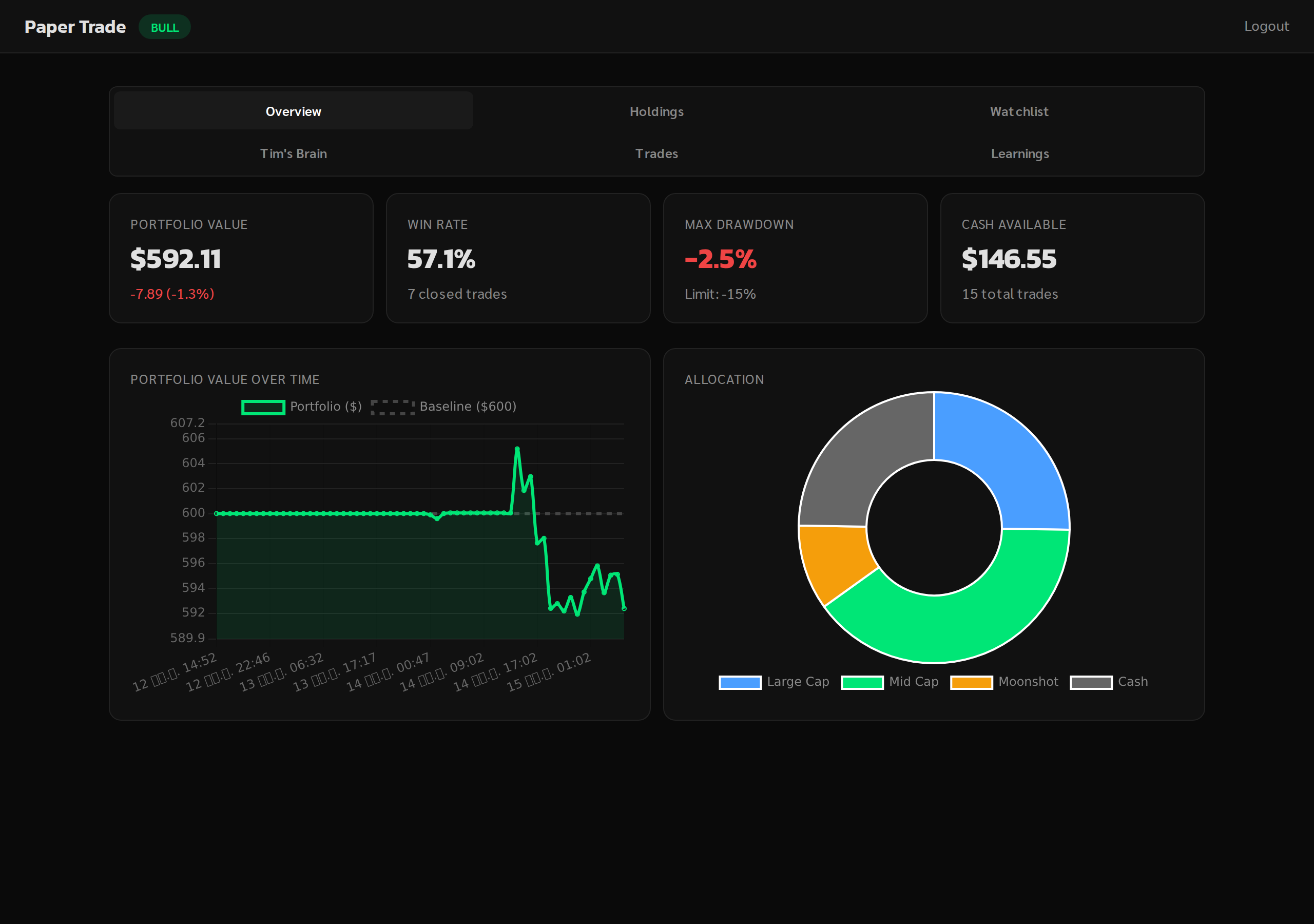
The Paper Trade dashboard — real portfolio tracking at $592.11, 57.1% win rate, allocation charts, all connected to live Binance data.
"But There Are Paper Trading Tools Already"
You're right. Let me walk you through them.
Exchange demo accounts (Binance Testnet, Bybit demo): They give you play money on a simulated order book. Sounds great, except the simulated order book doesn't behave like the real one. Slippage is different. Liquidity is different. And most demo accounts expire after 30 days — just when you're starting to learn something useful. Oh, and forget about testing automated strategies. API access on testnets is limited and unreliable.
Paper trading features (TradingView, Webull): These are better — they use real market data. But they're designed for manual trading only. Want to test an automated strategy? Want to connect your own scripts? Want API access to build alerts and triggers? "Upgrade to Premium" — and even then, the API access is limited. You're trapped inside their interface.
Build your own trading bot: This is the "correct" solution, technically. Except it requires deep knowledge of WebSocket programming, API authentication, order management, risk calculations, and data persistence. A competent developer would take 2-4 weeks. And then you need to maintain it — handle API changes, fix connection drops, update for new trading pairs. It's a full-time project.
Here's the real issue with all of these: they're frozen in time. You get what they give you, and that's it. Want to add a custom metric? Want to change how position sizing works? Want to integrate with a different exchange? You're either waiting for a feature request or hiring a developer.
My simulator doesn't have that limitation. Because the same AI that built it can modify it whenever I want. "Add support for a new trading pair." "Build a strategy backtester." "Create an alert when BTC drops 5% in an hour." Done in minutes.
Why I'm Telling You This
Because this story isn't really about crypto trading.
It's about the gap between having an idea for a tool and actually having that tool. I wanted a specific thing — a paper trading simulator with real data and full customization. That thing didn't exist in the form I needed. So I described it, and my AI agent built it.
You probably have your own version of this. A tool you wish existed. A system that would save you hours every week. An app that solves a problem nobody else has bothered to solve because your use case is too specific for a mass-market product.
The system I use — an AI agent on a private server that builds what you describe — is now available as a product. I call it Jarvis.
And here's what makes Jarvis fundamentally different from every AI coding tool, no-code platform, or chatbot out there:
Jarvis Doesn't Just Build — It Operates
- Your own private server — the AI agent lives there, not on your laptop
- It writes the code, connects the APIs, sets up the database, deploys everything
- It handles the hard stuff — WebSockets, API rate limiting, reconnection logic, data persistence
- After your system is live, it keeps running it — monitors, fixes, updates
- Need a new feature? Tell Jarvis — it's added in minutes, not weeks
- Talk to it like a colleague — describe what you want, it builds AND operates it
- Full access to your server — no vendor lock-in, you own everything
- Works 24/7 — your AI doesn't sleep, and neither do crypto markets
- Set up in under 2 minutes after payment
Other AI tools give you code. Jarvis gives you running systems.
My trading simulator didn't just get built — it's been running 24/7, connected to live Binance data, tracking simulated trades, every single day. When I want to add a new strategy or a new feature, I describe it to Tim, and it's live in minutes. No redeployment headaches. No debugging WebSocket connections. It just works.
I'm not going to pretend this is for everyone. If you don't have specific tools you want to build, Jarvis won't help. It's the most powerful building tool I've ever used — but it needs a person with ideas behind it.
But if you're the kind of person who sees a problem and immediately thinks "I wish I had a tool that..." — and the only thing stopping you is the technical barrier — this removes that barrier entirely.
Ready to Build the Tools You've Been Wishing For?
Get your own AI-powered server. Describe what you need. Watch it come to life.
Try Jarvis Now 7-day full refund — no questions asked