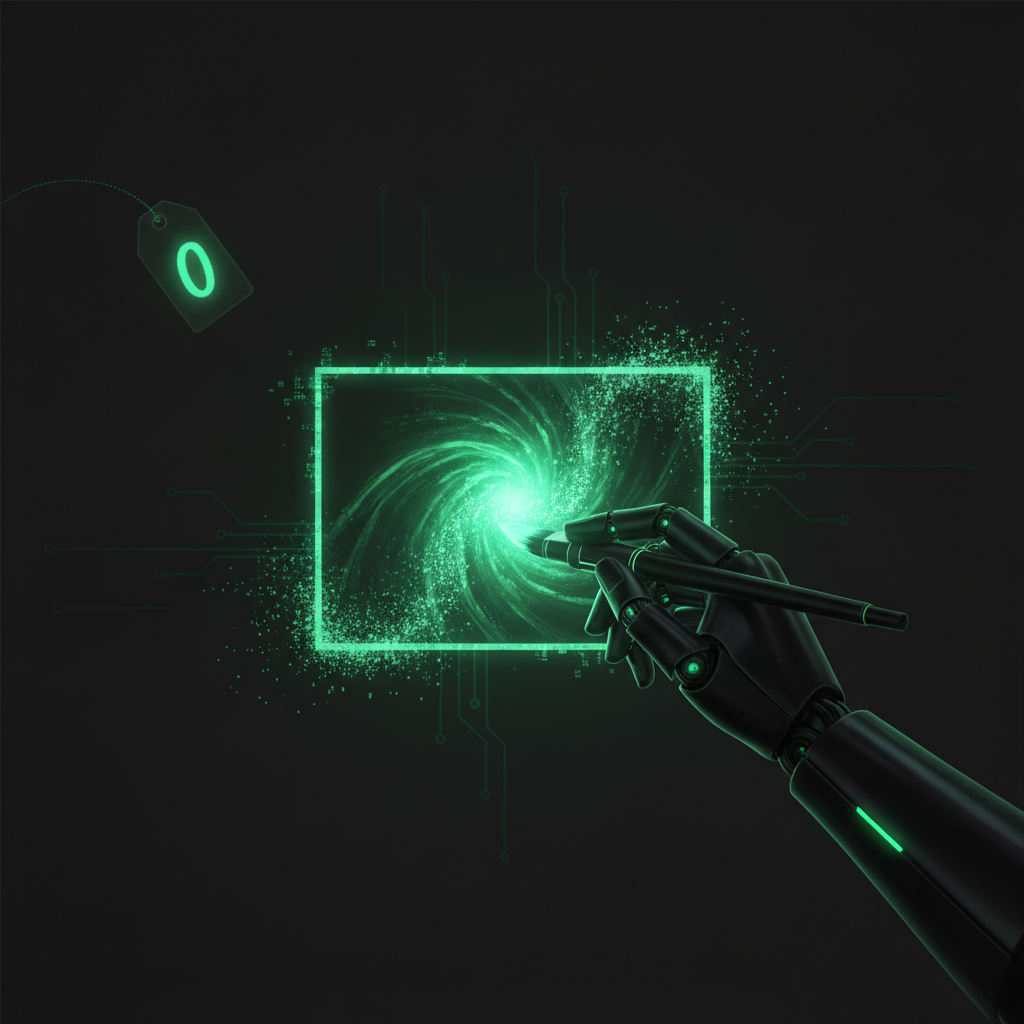
The dark image sitting at the top of this article — I didn't hire anyone to make it, I didn't pull it from a stock library, and most importantly, it didn't cost me a single cent. Tim, my AI agent, generated it himself the moment he finished writing this post.
That sounds like a small thing. But the part I want to talk about is that one word: free. Because for as long as I can remember, every time Tim made an image for me — a blog header, an ebook cover, an ad creative — there was a quiet little bill that came with it. Until one day I realized I'd been paying for the same job twice without knowing it.
Before: Every Image Was a Pay-Per-Picture Charge
I make a lot of content — several blog posts a day in both English and Thai, KDP book covers, Facebook ad images, website headers, and on and on. All of it gets generated by Tim using an AI image model (I use the Gemini / Nano Banana family).
The way it always worked was through an API key — a key sitting on my server, and every time the code wanted an image, it fired a request off to Google with that key attached. Google then billed me per image, per token. Every picture that came out added a tiny number to the end-of-month invoice.
Individually it's nothing — fractions of a cent to a few cents per image. But multiply that by the number of images per day, times 30 days, times however many months, and it becomes a constant little stream flowing out the door that I almost never looked at — because it was too small to ever catch my eye.
The Moment It Clicked: Wait, I Already Pay a Flat Subscription
The whole thing came to light when I added a third engine to Newton. When I brought Antigravity (I call it "agy" on my box) in as the third CLI alongside Claude and Codex, I started poking around to see what it could do.
Antigravity is Google's, and I already pay for its monthly subscription. And as I was playing with it, I discovered it has a built-in image generator (the same Nano Banana under the hood) — and crucially, generating an image through it counts against the flat monthly quota I'm already paying for. It does not run through a separate metered API.
The second I saw that, it hit me — hold on, that means I'm paying two different ways for the exact same job. On one side I pay flat for the Antigravity subscription every month (which includes an image quota whether I use it or not). On the other side I'm still paying a metered API charge every single time Tim makes a picture — for work that's completely identical.
It was the same shape as a story I told earlier, when I found out that the engine doing my text generation was secretly running on a pay-per-token meter even though I already had a flat subscription. That time it was about words. This time it was about images. Identical problem: paying twice because the tool happened to be plugged into the more expensive pipe, with nobody meaning for it to be that way.
Tim Tested It for Real — He Didn't Just Trust the Marketing
I didn't want to migrate the whole pipeline on a hunch that it "should" work. So I had Tim do the real thing on the server first — run agy in headless mode (a single command, no screen, no UI) to generate an image and save it straight to a file.
Here's what came back:
- It really generates images — one command produced a 1024×1024 file directly. No waiting for the AI to deliberate over whether it should; just a direct instruction in, image out.
- It doesn't touch API billing — this was the decisive part. When agy runs, it authenticates with the subscription token (from login). There's no API key in the environment at all. Which means there's no path for it to ever hit the metered API. It draws purely from the flat monthly quota.
- Cost per image = zero — as long as I stay inside the quota I'm already paying for every month.
This is exactly what I love about having an AI agent that actually lives on a real machine — it doesn't just say "this should be possible." It goes and tests it on my own server, then brings me the evidence that it actually works before changing anything. Same as the time it ran benchmarks itself to find out how much my AI's "thinking level" was overspending on tokens before adjusting it. Measure first, then move. Never guess.
But This Wasn't "Move Everything" — It Was "Route Each Job to the Right Pipe"
Here's the part I think matters most, the thing I want you to take away: Tim did not just dumbly shove everything over to agy and rip out the API key. Because free has limits too.
Tim walked me through the real constraints:
- The subscription image quota is a separate, capped pool. If I fire a hundred images a day through it, I'll hit the ceiling — and once the quota runs out, it falls back to metered billing anyway. So it's a bad fit for automation pipelines that blast images all day long.
- The model version isn't 100% guaranteed. When the top-tier quota runs dry, it may silently fall back to a lesser model. Quality might not be as stable as paying directly through the API.
So the conclusion Tim landed on was to split the work by type — manual / ad-hoc images I make one at a time (like the header on this very post, or a book cover I generate individually) go through agy on the flat quota = free. Meanwhile the heavy automation jobs, where a cron fires off batches of images all day (like a bulk ad pipeline), keep using the API key so throughput stays stable and quality stays consistent.
The result: I cut almost all the cost out of the "hand-made, one-at-a-time image" bucket, without putting any risk on the customer-facing work that needs to be rock-solid. Cheaper and no surprises.
Three Lessons I'm Keeping From This
1. The most dangerous costs are the ones too small to notice. A few cents per image never once made me flinch — but it leaked out every day, for months, for years. Those are exactly the costs that need someone keeping an eye on them, and an AI agent that lives on your machine is the one best positioned to spot them — because it sees both the bill and the alternatives.
2. Use what you already pay for before you pay again. If you're already on a flat monthly subscription and it can do the job within quota, paying extra through a second metered pipe for the same task is just paying twice for nothing. Check which pipe your tools are actually plugged into.
3. The best answer is usually "split by job," not "move everything." Free is great for light work; paid is great for heavy work that has to stay stable. Knowing which job belongs in which pipe is what lets you save money without breaking quality.
Why a Tiny Thing Like This Matters So Much for a One-Person Business
Think about it — if I didn't have Tim, how would I ever know my image tool was plugged into the wrong pipe? I'd have to dig through the code to see which part calls the API key and which calls the subscription, know that Antigravity even has a built-in image tool, test for myself how it authenticates, and then decide which jobs belong where. For someone who isn't an engineer, finding this on your own is almost impossible. It would just keep quietly leaking, forever.
But Tim handled all of it, because he's Claude Code actually running on my server — he sees the real files, the real config, runs real test commands on the box, and comes back to me with "hey, you can save money right here, want to?" Not a chatbot that answers in the abstract and leaves the doing to me. And because it's the same Tim controlling all three engines, he's the one who knew which of them had a free image tool to pull from in the first place.
The catch is that standing up a server + AI + multiple connected subscriptions + a memory system + a skill system the way Tim has it usually takes days of fiddling before it's tuned right. So I packaged it into Newton — I hand you a server with your own private AI agent (just like Tim), ready to go, nothing to set up yourself. It sits on your machine, sees your real work, and hunts down exactly these kinds of savings for you. Take a look here — there's a 7-day trial so you can see for yourself whether it actually does the work and saves you money like this before you decide to pay.
— Pond